Known facts concerning Sgt Weiser are:
He was one of three crew members who
was able to parachute and land safely.
He landed in Ongata Village , located close to Hachioji.
He was captured by civilians and stoned to death.
His remains were buried in a temple at Ongata Village.
When recovered, his dog tags were missing.
The recovery team was unable to sketch a tooth chart.
Unknowns are:
The date of his recovery.
How did the recovery team learn
where to find his remains.
______________________
In Capt Samuelson's IDPF is a Report of Recovery.
The unit was the 3061st QM Graves Registration Company.
Team 2 Job 4 ( T2J4 )
This team was in the area of the crash location.
Sgt Weiser is mentioned with the words
" see report of T2J5 "
Unfortunately, this report is not in his IDPF.
His identification was based on Japanese Burial Records.
The source of this record is not stated in his IDPF
___________________________
The Office of the Quartermaster General published
two series following the end of WWII :
Series I 1943-1951 ( 21 monographs )
Series II 1956-1957 ( 4 monographs )
Edward Steere was the author of #21 in Series I :
The Graves Service in World War II ( 1951 ).
source: State Library of Massachusetts
Digitized by Google Books
____________________________
Final Disposition of WW II Dead
was the fourth in Series II, published in 1957.
Authors : Edward Steere and Thayer M Boardman
source: State Library of Massachusetts
Selected pages from each publication are in these four pages.
None are specific to Sgt Weiser.
_______
The early teams were initially searching for POWs in the camps.
Most of these locations were known, some were not.
A more difficult situation concerned plane crews .
It is noted in the following pages that, as you might expect,
the civilian population was hostile towards the recovery teams.
There was a reluctance to tell what
they knew for fear of potential war crimes.
________________________
With this in mind, how were Sgt Weiser's remains
discovered at such an early date ?
The first American Occupation Units
arrived in early September 1945.
The Americal Division was one of them.
Based on his status as Unknown X-9 at
United States Armed Forces ( USAF ) Cemetery Yokohama #1,
this could have taken place some time in early October 1945.
_____________
Within this section is an overview of the situation that the
Graves Registration Service ( GRS )
encountered following Japan's surrender in September 1945.
These may help to better understand the process
not mentioned in Sgt Weiser's IDPF.
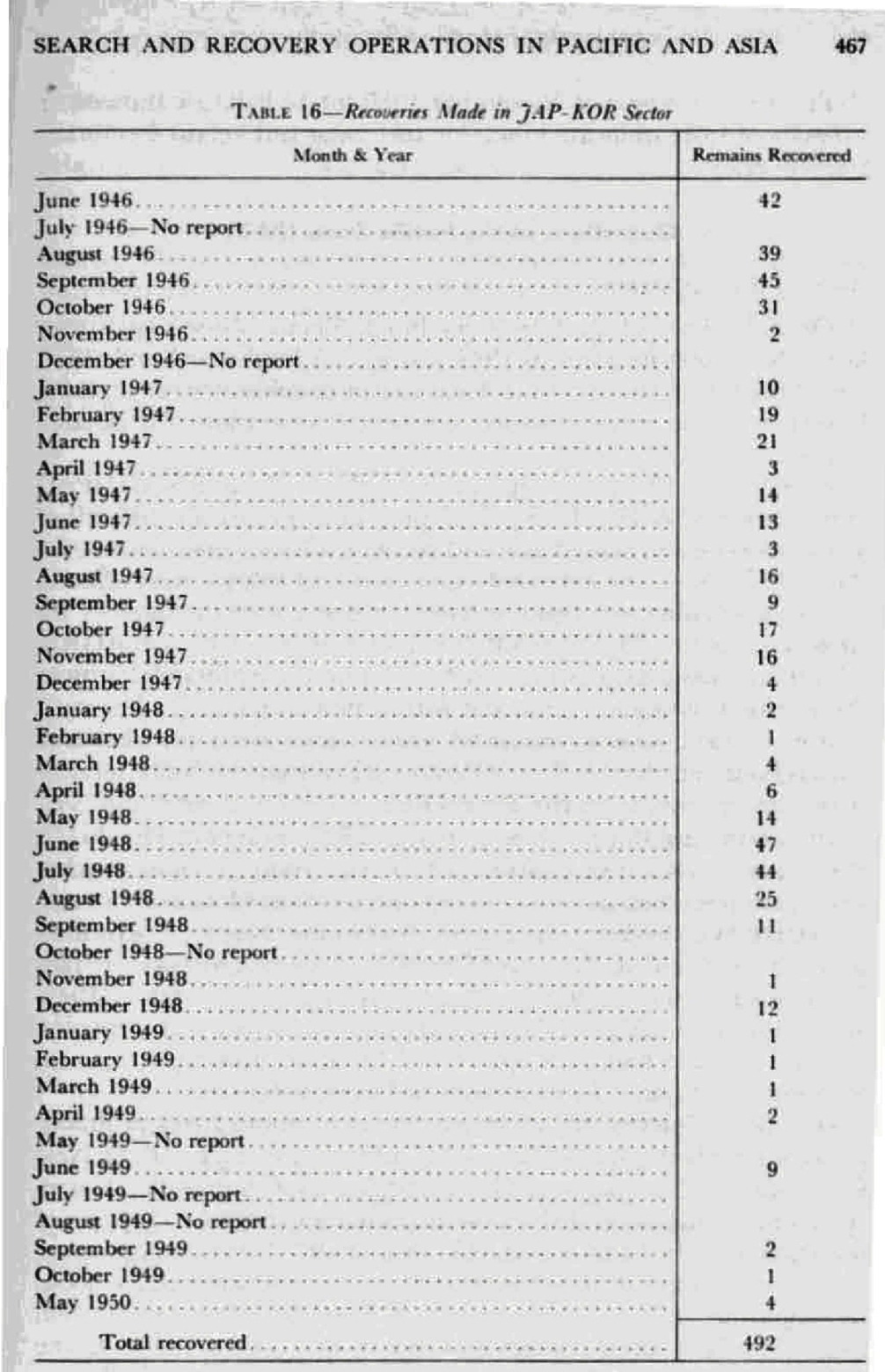
The first table concerns recoveries made in
the Japanese - Korea Sector.
( JAP - KOR )
Note that data begins in June 1946.
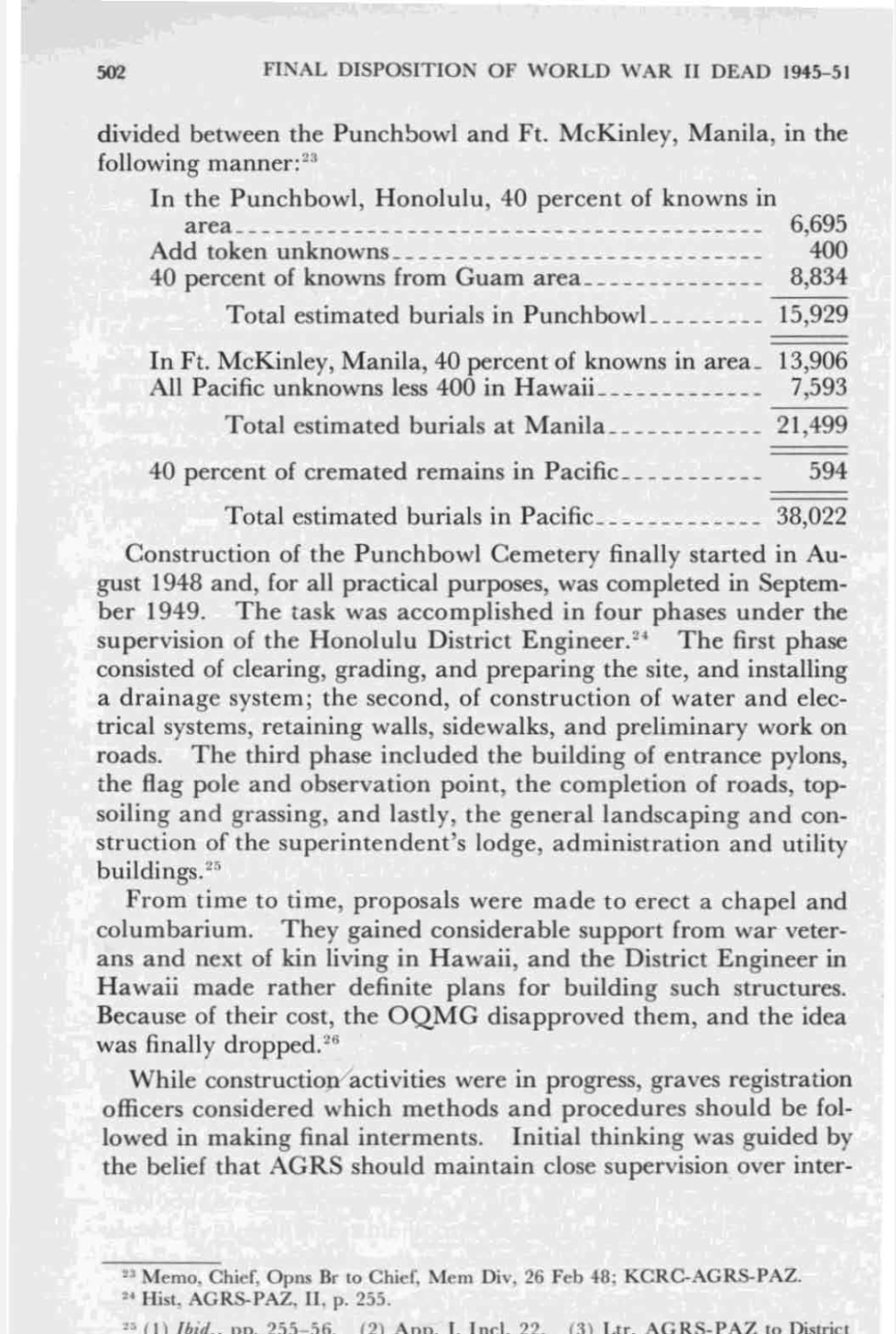
The second page summarizes the status of remains
at the Cemeteries in Honolulu and Manila.
BACK TO TOP